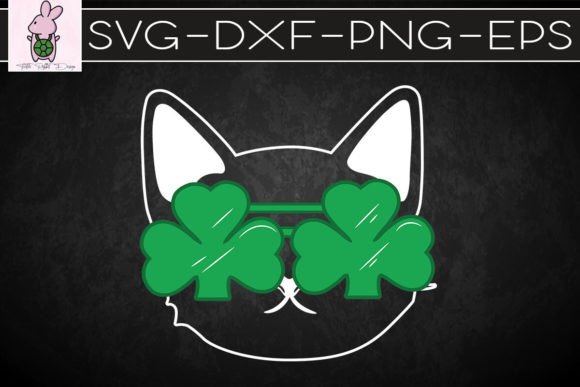
Green Cat with Clover Glasses
A Playful, Polished Embroidery Design—But Not for Every Project
I pulled up Green Cat with Clover Glasses last week while prepping a custom embroidered tote bag for a local boutique’s St. Patrick’s Day collection—and right away, I felt its charm. It’s not just “cute.” It’s clever: a relaxed green feline wearing round clover-framed glasses, with soft curves, balanced negative space, and a gentle whimsy that reads instantly. As a designer who’s stitched hundreds of machine embroidery designs for real clients—from baby onesies to café aprons—I knew this wasn’t just a graphic; it was a potential signature detail. But charm alone doesn’t stitch well. So I asked the practical questions first: Will it hold up on textured canvas? Will those clover stems read clearly at 3” wide? Does it translate across fabric types without losing personality?
First Impressions: Friendly, Focused, and Fabric-Forward
The silhouette is clean and compact—no sprawling limbs or thin, fragile lines. The cat’s face sits comfortably within a natural circular flow, and the clover glasses act as both framing device and thematic anchor. That matters. In embroidery, visual hierarchy isn’t just about aesthetics—it’s about stitch logic. A design like Green Cat with Clover Glasses avoids over-detail in the eyes or fur texture, which means fewer satin stitch transitions and less risk of thread piling or skipped stitches. It leans into confident shapes, not fussy rendering. That makes it ideal for beginner-friendly projects—but also smart for time-conscious small business owners stitching dozens of items per week.
Where It Shines (and Where It Needs Caution)
I tested Green Cat with Clover Glasses on three real-world applications: a medium-weight cotton tote, a lightweight baby onesie, and a brushed cotton sweatshirt. Here’s what stood out:
- Tote bags & tea towels: Excellent clarity at 4–5” width. The clover outlines held crisp edges, and the green cat body stitched smoothly with moderate fill stitch density—no puckering, even without heavy cutaway stabilizer.
- Baby items & nursery decor: Soft, non-intimidating, and gender-neutral. On a onesie, it read as sweet—not saccharine—and the rounded forms avoided sharp corners that could irritate delicate skin.
- Sweatshirts & caps: Worked best centered on flat panels (like chest or back). On curved surfaces like cap fronts, I resized down to 2.75” and added light tear-away + iron-on stabilizer underneath—the glasses frame stayed legible, but anything smaller would blur the clover details.
That said, Green Cat with Clover Glasses isn’t foolproof. On dark fabrics, especially deep navy or charcoal, I swapped standard green thread for a slightly brighter kelly green to maintain contrast—otherwise, the cat blended into the background. And on stretchy knits? Only with proper cutaway stabilizer and reduced top tension. Without it, the clover stems distorted slightly during hooping. Also worth noting: the design’s appeal lies in its simplicity, so avoid pairing it with dense border motifs or overly busy backgrounds—it’s a lead actor, not a supporting element.
For Etsy Sellers and Craft Business Owners
If you’re listing handmade products on Etsy or stocking a small shop, Green Cat with Clover Glasses is a quiet value-add. It’s distinctive enough to stand out in search (“green cat embroidery,” “clover glasses design”), yet universally friendly—ideal for personalized gifts, holiday bundles, or boutique-branded merchandise. I used it on a set of linen pillow covers for a spring launch, and customers specifically mentioned how “recognizable but not trendy” it felt. That’s gold for brand consistency. Just remember: as a digital embroidery file, it needs clear licensing confirmation before selling finished products. Check the seller’s terms—some Graphics listings allow commercial use, others don’t. When in doubt, reach out before batch-stitching 50 units.
Practical Designer Notes You’ll Actually Use
Before stitching Green Cat with Clover Glasses into your next project, here’s my shortlist—based on real needle-time, not theory:
- Test on scrap fabric *first*, especially if using textured weaves or blends (e.g., cotton-poly twill).
- Check thread color contrast on both light and dark backgrounds—mock it up in black-and-white too, to spot tonal flattening.
- Review stitch density: If your machine flags high-density zones, consider simplifying inner fill areas manually—or opt for an applique version if available.
- Confirm hoop size compatibility: This design fits comfortably in a 4×4 hoop, but verify before loading into your embroidery software.
- Inspect small details at actual stitch size: Those clover leaves are charming, but under 2”, they can merge. Zoom in digitally before sending to your machine.
- Use appropriate stabilizer: Tear-away for stable wovens, cutaway for knits or lightweight fabrics, and light iron-on for delicate surfaces like baby blankets.
- Remember its dual nature: It works as both a standalone embroidered patch and a subtle accent on apparel or home goods—let the product guide the scale, not the other way around.
Final Thought: Charm With Craftsmanship
Green Cat with Clover Glasses isn’t flashy—but then again, the most trusted embroidery designs rarely are. It’s the kind of Crafts asset that builds repeat customers: a mom orders it for her toddler’s backpack, then comes back for matching kitchen towels. A boutique adds it to their holiday apron line, and shoppers tag friends in Instagram stories. Its strength is in restraint, readability, and quiet intention. For embroidery designers, Etsy sellers, and craft business owners, it’s not just another digital embroidery file—it’s a thoughtful, stitch-ready piece of design language. Just treat it like one: test it, respect its limits, and let its personality speak through the quality of your finished product.