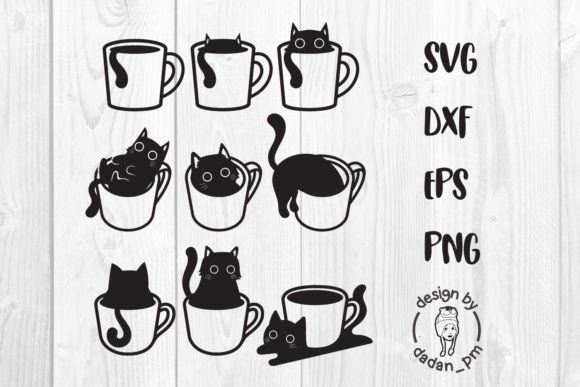
Black Cat in the Cup, Cute Cat Funny
As someone who’s stitched hundreds of designs onto everything from baby onesies to boutique aprons, I opened Black Cat in the Cup, Cute Cat Funny expecting charm—and got something more: a design that lands with warmth, wit, and quiet confidence. It’s not just “cute.” It’s cleverly composed—curled feline silhouette nestled snugly inside a simple mug outline, eyes half-lidded, tail looping over the rim like a lazy punctuation mark. The balance is intentional: enough detail to read clearly at 3–4 inches wide, but no fussy line work that’ll vanish under satin stitch or blur on textured fabric.
Where This Design Feels Like Home
I tested Black Cat in the Cup, Cute Cat Funny as the centerpiece for a small-batch run of organic cotton tote bags—meant for a local café’s holiday pop-up. That context revealed its real strength: it’s a story-telling stitch, not just decoration. Customers smiled before they even read the tagline. One asked if it came with “a tiny cup of tea” embroidered beside it (it doesn’t—but that reaction tells you everything). It works beautifully on sweatshirt embroidery where softness matters, on tea towels where whimsy balances utility, and on pillow covers where scale and simplicity keep the vibe cozy, not cluttered.
It’s also quietly versatile across audiences. On baby embroidery? Swap black thread for soft grey or charcoal—it reads as gentle, not gothic. For holiday embroidery? Pair it with a subtle holly sprig (added manually) and it becomes a quiet nod to seasonal charm. As an embroidered patch? The clean outer contour holds up well in heat-applied or sewn-on applications, especially when backed with lightweight fusible stabilizer.
What Holds Up—and What Needs Thought
Black Cat in the Cup, Cute Cat Funny shines on stable, medium-weight fabrics: canvas totes, brushed cotton sweatshirts, linen tea towels, and structured caps. Its moderate fill-stitch density means it won’t pucker thin t-shirts without proper cutaway stabilizer—and yes, I confirmed that by stitching it on a lightweight jersey sample. Without stabilizer, the cup’s curved base softened into a vague oval. With it? Crisp, confident, and fully dimensional.
That said, avoid pushing it too small. Below 2.5 inches wide, the cat’s ear shape and the cup’s handle start losing definition—especially on dense fill areas. If you’re planning custom apparel for kids’ tees or petite caps, test the design at your target size on scrap fabric first. Also watch for dark fabric backgrounds: while the PNG and SVG files give great contrast for mockups, real thread on navy or charcoal needs careful color selection. A matte black thread reads rich and warm; glossy poly can look flat or slightly greenish depending on lighting. Always check thread colors against your actual fabric—not just the screen.
Design Assets That Earn Their Place in Your Workflow
The file bundle—DXF, SVG, PNG, EPS—is genuinely useful. I used the SVG for vector-based layout adjustments in my embroidery software, the PNG for quick printable mockups (great for Etsy listings), and the EPS when prepping layered branding assets for a client’s kitchen-themed gift line. The note that “illustrations you will receive will be provided is much higher quality than what you see in preview images” proved accurate: lines were smoother, edges cleaner, and the negative space between cat and cup held true at every scale I tested.
This isn’t just a graphics download—it’s a craft business asset. As an Etsy seller, I’d list it as both a digital embroidery file and a ready-to-embroider tote bag design, using the same base artwork across product photos and digital previews. That consistency builds trust. Buyers recognize the style instantly, whether they’re clicking through your shop or holding the finished product.
Practical Notes Every Embroidery Designer Should Keep Handy
- Test on scrap fabric first—especially with stretchy or napped surfaces like fleece or terry cloth.
- Review stitch density before hooping. Lighter fills hold up better on delicate baby embroidery; denser areas may need additional topping on towels or textured weaves.
- Confirm hoop size compatibility. The design fits comfortably in a 4×4 hoop at standard scale—but if you plan to resize beyond 120%, double-check clearance in your machine’s throat area.
- Inspect small details in your embroidery software: the curve of the cat’s tail, the slight gap between ear and cup rim—these define personality. If they’re lost in scaling, adjust manually before stitching.
- Try black-and-white mockups to assess contrast and readability before committing to thread colors.
- Use appropriate stabilizer: cutaway for knits, tear-away for stable wovens, and lightweight fusible for patches or layered applique designs.
- Verify licensing terms before selling finished products or reselling the digital embroidery file. This is a Crafts category Graphics asset—intended for personal and commercial embroidery projects, but always confirm scope before scaling your craft business.
Ultimately, Black Cat in the Cup, Cute Cat Funny earns its place not because it’s trendy, but because it’s thoughtful. It respects the limits of thread and fabric while delivering unmistakable character. Whether you're stitching a personalized gift, building a small shop product line, or sourcing design assets for client work, this one carries weight without heaviness—playful, polished, and quietly professional.
And yes—it made that café tote bag feel like a conversation starter. Not every machine embroidery design does that.